
College
How To Study In College: Focused Preparation


I’ll be doing a series titled How To Study In College. The first post in the series is The Chip Away Strategy.
Does this scenario sound familiar? You have an upcoming test and you plan out how many hours you should study. You decide that five hours straight the night before, and five hours straight the day of the exam will be more than enough. You study in two long stretches. Now you are confident for the test because you prepared 10 good hours. Then, you take the exam. You struggle and don’t do well. You get frustrated that you spent so much time studying and didn’t get rewarded.
But, is studying for long periods of time effective studying? No, it’s not. Will studying like this get you an A on the exam? Probably not, and I’ll tell you why.
Total Study Time
Total study time includes all the time spent on the phone, talking to friends, getting coffee, going to the bathroom, and mindlessly preparing with an exhausted brain. After doing bad on an exam, people say, “I studied forever,” as their reasoning that a teacher or class sucks.
Total study time is dangerous because it gives a false sense of adequate preparation going into an exam. Like the example above, it is easy to believe with confidence that 10 hours of studying is enough to do well, or even ace the test. But, so often total study time is done in one or two long periods, where students soon become tired and unfocused. It’s only in the first and second hour of studying that students can best focus and prepare to improve their memory and knowledge of the material. Then the brain gets tired and unfocused, and the rest of the time studying produces little to no results. So, while they believe they studied hard for 10 hours, in reality they only have a couple hours of good preparation for the test. Total study time tricked them.
When your brain starts to get tired, it’s easy to mindlessly study and take shortcuts. You could go through vocabulary words, get one wrong, and then think, “I should have known that,” as you flip the flash card in the correct pile because you don’t want to go through them another time. Or you could skim a reading that you need to read in detail. The point is you can’t effectively study with a tired brain. Unfocused studying also leads to bad habits that are hard to avoid the next time you study. And guess what? You’re setting yourself up for a bad exam if you study unfocused, and then try to focus when you take the exam. Your brain hasn’t practiced processing the information when it is focused.
A Difficult Learning Experience
I once studied around 30 hours for a Microbiology exam my freshman year. I studied every night, all night, for the entire week. I remembered thinking something along the lines of pain is temporary, my GPA is forever. I couldn’t believe when I got the exam back and received an 84%. I thought something was wrong with me. I had done everything I could, so I thought, and received a B.
Looking back, I studied so poorly for that exam. I (foolishly) put studying last on my day’s activity list all week, because I thought since I was spending so much time that I could afford to. My brain had to process and react in my classes, with friends, and on my other homework, all before I began studying for the Microbiology exam. I probably effectively studied four or five hours out of the 30 total hours. No wonder I didn’t score as high as I wanted. And I committed dumb exam mistakes.
Focused Study Time
Excuse me if this is obvious, but focused study time is the amount of time you spent effectively studying without any distractions and with a fresh brain.
Focused studying is one of the most important things to learn in college, because it gives you more production while taking less time. When you start studying and your brain is fresh, you’re preparing at a high-level. So, for example, let’s say your mental inferences are firing at 100% during the first hour. Then during hour two, your brain is working around 90%. At this point, you’re slowing down a little but still preparing well. At hour three, your brain is tired and down to 50% of the production as hour one. Study past hour three and your brain is fried.
Example comparison:
Student 1, who studies 12 hours total in the night of and the morning before the exam:
Percent Production
During the night of the exam: 100% (hour 1), 90% (hour 2), 50% (hour 3), 25% (hour 4), 10% (hour 5), 5% (hour 6) = 280% production
During the day of the exam: 100% (hour 7), 90% (hour 8), 50% (hour 9), 25% (hour 10), 10% (hour 11), 5% (hour 12) = 280% production
Student 1: studied 12 hours, 560% production
—–
Student 2, who studies 8 hours total—broken down into four days of two hours:
Percent Production
Four nights before the exam: 100% (hour 1), 90% (hour 2) = 190% production
Three nights before the exam: 100% (hour 3), 90% (hour 4) = 190% production
Two nights before the exam: 100% (hour 5), 90% (hour 6) = 190% production
The night of the exam: 100% (hour 7), 90% (hour 8) = 190% production
Student 2: studied 8 hours, 760% production
—–
Student 2 was more productive by 200%, studied four hours less, and avoided unnecessary stress and anxiety.
Prepare for your exam in short periods of two to three hours, not long extended periods, and you’ll utilize your time because you’ll study only at a high-level. This way, you can confidently go into the exam knowing that you prepared right, and you didn’t waste time where your brain barely processed information. Focused studying with breaks in between will get you a high GPA, without sacrificing fun college experiences. Study smarter, not harder.
If you didn’t plan ahead and have an exam the next day, study for three hours. Then take time to relax and rest. Eat and drink for energy. Then study for two more hours and call it a night. Wake up early and repeat the same process as the night before. This is a much better effective studying technique than staying up all night.
If you can master focused production, you’ll run laps around your competition while you enjoy college.
Tips For Effective Focused Studying
1) Take a 10-minute break after every 50-60 minutes of studying.
Breaks are important for keeping your brain fresh.
2) Study in the library by yourself.
A cubicle in the library eliminates a loud TV, talking roommates, and the comfort of your bed. After you do focused studying, spend the extra time you saved to catch up with your friends.
3) Turn your phone off.
Your phone is the number one enemy in the way of effective, focused studying. The instant access to texting, Internet, or social media apps is always more desirable than studying. If you don’t trust yourself, put your phone in your backpack.
4) Exercise, eat healthy, and rest.
The extra energy from these three activities is the gas to your focused machine.
5) Study during your productive time.
Most people find mornings and afternoons as their most productive time, because they have more energy. But, if you’re naturally more productive at night, study then.
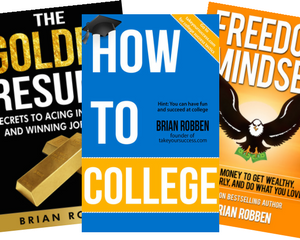
For more ways to ace college, check out my bestselling book How To College!

So, there you are: a happy, healthy college student. You’re attending lectures, writing papers, going to parties, holding down internships — and planning to go to business school someday.
But that day seems far in the future, and you’re not worried about taking the GMAT yet.
You known you’ll need to get some work experience before you can start putting together b-school applications, so taking the GMAT while you’re still in college doesn’t even make sense — or does it?
Actually, it does. GMAT scores don’t expire for five years, so if you take the test in your junior or senior year, you’ll still have time to gain work experience before enrolling in an MBA program.
And taking the test while you’re still in college all but guarantees a higher score. Here’s why.
You’ll Never Have Better Test-Taking Skills
As a college student, you’re accustomed to taking tests regularly. You probably have at least two exams per class each semester. You’re also taking tests and quizzes pretty regularly. You’ve been accustomed to taking regular tests for years now because you’ve been in school nearly all your life.
That means your test-taking skills are at their zenith. You know how to effectively study for a test.
You understand how to use study guides to prepare. You probably also know how to use practice tests to the best advantage. You know how to interpret test questions. You’re familiar with the testing environment. You have an established and battle-tested routine that you use to prepare for tests and keep yourself calm, both in the run-up to an important exam and during the exam itself.
As soon as you finish school, all of the test-taking skills you’ve learned over the past 12 to 16 years are going to start deteriorating.
If you graduate and work for a few years before sitting your GMAT, it’ll be harder to get into the groove of that old routine. Your study skills will be rusty. You’ll be unfamiliar with the testing environment and the test itself. You’ll suffer more anxiety.
All of these could hold you back from your best score.
Your Knowledge Is Fresh
Taking the test early is one of the most common GMAT tips for another good reason: When you’re still in school, your knowledge of the subject matter on the test is still fresh.
Most test-takers, at least those who speak English as a first language, struggle more with the quant section than the verbal section.
You learned the math covered in the test in high school, or in an intro mathematics class in college, but the further in the past those courses are for you, the more you’ll have forgotten and have to relearn.
Taking the test early ensures you can maximize your score while minimizing your study time.
You Can Better Plan Your Application Strategy
Your GMAT score is an important part of your b-school applications, and that’s why many students invest months and some spend thousands on studying and tutoring to prepare.
Just taking the test is expensive, and you may be leery of spending the money if you don’t think you can earn your best score. But GMAT scores are just one component of a successful b-school application, and knowing your score early on can help you form a plan of attack that will get you a spot in the b-school of your choice, even if your score isn’t as high as it could be.
If you take the test in college and don’t score as well as you’d hoped, you still have plenty of time to keep studying and retake it. Or, if you don’t want to retake it, or you’re concerned that retaking won’t help much, you can take other steps to strengthen your b-school application.
If you’re a junior or senior in college, you’ll have time to plan for internships, extracurricular activities and work experience that will get your foot in the door at the b-school of your choice, even if you don’t have a 700+ score. People get into MBA programs with low GMAT scores all the time, as long as other parts of their application are strong.
Knowing about this weak point in your application will enable you to work with MBA admissions counselors to strengthen your application and your chances.
If you’re planning on going to b-school someday, taking the GMAT while you’re still in college is a great idea. You’ll be better-equipped to excel on the test, and knowing your school early can help you prepare better MBA applications.
Don’t wait; start prepping for the GMAT now, and make your MBA dreams come true.
Summer is just around the corner and everyone seems to be getting ready for their internships. If for some reason or another you aren’t taking that path this summer, it’s completely fine. There are a bunch of things you can do over the next couple of months that will help build your resume for the next internship and job-hunting season.
Here are 5 of the best things you can do to for your resume this summer:
Volunteer
Volunteering is a great way to spend your summer. Employers love to see people who have taken the time to give back to their communities; it shows selflessness and initiative, as well as a capacity to work well with others and contribute in a group environment. It also alludes to your ability to make the office-community a friendlier and more cooperative place of work, something all companies want.
Best of all, you can pretty much choose any cause you want to devote your time to and it’ll look good. Things like animal shelters, soup kitchens, elderly homes, and little league are all great. Plus you’ll actually be helping your community while beefing up your resume, so it’s a win-win for everyone.
It’s also a great opportunity to develop new soft skills such as leadership, communication, problem-solving, and conflict resolution. Those words look great on a resume, and they can be acquired and honed in through your role as a volunteer. You’ll also acquire experiences you can talk about in an interview setting, and demonstrate your value through those stories.
However, if you are going to volunteer, it’s important to not only look for roles in causes you’re passionate about, but also where you’ll be able to acquire those skills. It’s painfully obvious when someone does something just to put it on their resume, and a disingenuous attempt at a summer volunteer job will be an easy catch. Most places are looking for volunteers anyway, might as well choose the ones that will give your resume some real added value.
Learn A Hard-Skill
The “skills” section of your resume can make or break an offer. Bosses want their employees to have at least the basic skills necessary to perform a job before they agree to bring them onboard, and this is especially true of online-tool literacy. Being able to put “expert” on a tool or program (and mean it), or better yet have a certificate demonstrating your mastery of it, can go a very long way.
So if for example your area of interest is business, a certificate in an excel course from a community college or reputable online website is huge. The same goes for designers and photoshop, mathematicians and matlab, and filmmakers and Premiere pro. Having the basics of these programs down will give you a leg up when it comes to applying for jobs that use them on a daily basis. It’s one less thing they would have to teach, and therefore one more reason to hire you.
There are a number of free and pay websites dedicated to providing online courses for students, many of whom also give certificates of completion. Codecademy is great for those who want to sharpen their coding and web-development skills, GCF is for learning excel and other online tools, and Khan Academy covers a wide range of concepts from math and finance, to the arts & humanities. Take advantage of these tools, and you’ll be in a much better position for future job openings.
Work – Don’t Intern
You don’t have to have an internship to “work” during summer. A part-time job is a great alternative to slap on a resume because it demonstrates drive and willingness take on responsibility. The extra cash can come in handy during the summer weekends too. Also, if you have a good relationship with your boss, you have a solid referral for when the next job opportunity comes around.
Also, similar to a volunteering position, you can acquire skills and experiences that will help build up your resume. The good thing about an actual job though, besides the getting paid of course, is that you can gain experience in real job-related fields such as sales, customer-service, management assistance, etc. Your experience in these can help differentiate you from others who haven’t had the the same exposure to real work in those areas.
Another option is to work on your own projects. This one is tough because it requires a lot of self-motivation and discipline on your part, but if something meaningful and material does come of it, it can prove a very attractive point on a resume. It also allows you to be your own boss, and put your energy towards something you’re interested in.
Finally, eligible students may not know that they can get work-study while taking classes during the summer. In general, schools determine who is eligible for work study based on your completed FAFSA application, contact your school to if out if your work study program extends into summer sessions to see if this is an opportunity for you.
Network
“It’s not what you know, it’s who you know”, we’ve all rolled our eyes at that one before. You can’t put the names of who you know on a resume, and most of the best places to work have strict merit-based hiring policies where favoritism is actively blocked- that’s part of what makes them the best. So how can networking help your resume?
A solid network (i.e. knowing the right people) is a fundamental part of a successful career. The important thing though is to approach it from a mentality of “who will help me be successful at my next job”, rather than “who can get me my next job”. If you’re successful in your role, your bosses will by default share in that success. That’s why besides looking for people with the right skills and experience, they will often seek out those who have the connections and knowledge of industry players to do their jobs well.
There are various ways to show you “know the right people” on your resume. One is to join an industry networking club or non-profit. Some fields will be more prone to this kind of planned, constructed, centralized networking. They usually operate through topic-specific events which are attended by people with different levels of seniority from many companies. If you say you’re part of that “club” it’ll imply that you have some connections in the industry you can speak of. Another way is to become involved in the alumni association of your school. It may not be industry specific, but again it implies you have relationships with professionals. The key to this is that it starts the conversation about networking, so that even if you haven’t met anyone of note at events, you can slide those who are worth mentioning into the conversation without making it too obvious you’re flexing those relationships.
Become An Expert In An Unrelated Topic
A resumes’ main objective is to show that your skills and experience match what the job requires, but it should also illuminate who you are as a person and whether you fit the company culture or not. This is where the “interests and activities” portion of your cv comes into play, and where learning about an unrelated topic can help you advance through the job market.
Employers want to see applicants who are motivated and “hungry” in their work, but also in other aspects of life as well. Most entry-level jobs come with a steep learning curve, and a person who is curious and diligent about their interests will probably be better able to apply those qualities to the challenges of a new job. Even more, an interesting topic on your resume allows you to demonstrate your knowledge on a subject in which you’re articulate. In other words, it gives you the opportunity to look smart.
There are plenty of articles, books, and documentaries you can learn from to get better acquainted with a topic of interest. If you want to bump it up a notch though, MIT and Stanford each have their own catalog of free courses that are actually taught at those universities. There are sites like Coursera and edX which offer courses from many schools too. These will give you high-quality college level understanding of a topic, all planned out, easily accessible, and mostly for free. It’s a great platform through which you can be productive and build your resume in the process.
At the end of the day what your resume will really do is provide talking points you can elaborate on for an employer. As long as those points are relevant, interesting, and make you look good, they’re worth your time. The key though is to be able to demonstrate how they have prepared you for the job you’re applying for. Whether it’s developing your soft or hard skills, volunteering, learning new things, working, or just being productive with your time- your resume should reflect a well-rounded person, and that means working hard during the summer even when you don’t have an internship.
Who should read a law school admissions book? Just every pre-law student who cares about getting into their dream school, minimizing debt, and having a successful legal career.
If none of that applies to you, then you should stop reading right now. See ya never.
On a serious note, these books offer practical, real-world insight from admissions officers and lawyers who have already gone through what you’re about to. So take their proven advice and run with it to gain an edge on your peers!
It’d be outright reckless to not take their advice. The logic of winging your entire law school experience because you didn’t feel like reading a book doesn’t work out well.
So get wise by picking up one, or all three, of the books mentioned below. Then take action to not only avoid costly mistakes, but to become a highly sought after candidate.
Using the wisdom in these books, you can increase your admissions chances tenfold!
Most Helpful Books For Pre-Law Students
1. How To Get Into The Top Law Schools by Richard Montauk
If you’re an ambitious hustler who has dreams of attending somewhere like Stanford Law, don’t mess around with any admissions book from the public library.
Do it right: get this book specifically constructed for undergrads striving to get admitted to the top law schools in the US.
The author lays out why top law schools are incredibly attractive, as they are competitive:
The reason it is so difficult to get into these schools is clear. The value of a law degree from a top school is immense. Graduates of top schools earn salaries that are, on average, double or triple (or more) of what graduates from lesser schools make. Increased salaries are not the end of the story. Greater career choice, increased job security, more interesting work, and numerous other benefits also result from a top law degree, so it is no wonder that so many people want to get into the best school they can manage.
For those who are up to the challenge, getting into the best law school you can is simplified with this guide. You’ll learn how to market yourself to schools, write a persuasive essay, ace interviews, and choose the right university, among other gems.
Funny thing is I’ve actually worked one-on-one with the author, Richard Montauk, when I was a college junior obsessed with going to law school.
Why did I call him first and eventually go through his expensive coaching calls? Because the content in his book made a significant impact in advancing my law school admissions strategy.
You don’t need to pay him for coaching, but you do need to read this book—especially if you want to go to a top 14 law school.
2. The Ivey Guide To Law School Admissions by Anna Ivey
This admissions guide comes from none other than Anna Ivey, the former dean of admissions at a top five law school—The University of Chicago Law School. In other words, like the most qualified person ever for answering admissions questions.
She masterfully takes the readers through how admissions officers think, points out how to improve your chances, and uses examples of actual applications to prove her points.
While Montauk’s book does include specifics, Ivey’s is broken down into easier to consume chapters of how to impress with your essay, resume, interviews, and more.
Even if you’re well read on this topic, Ivey’s book is a must read to get the edge where you’re application is lacking.
The fact a former head of law school admissions at a spectacular school has a book out should be motivating enough.
If you’re smart, you’ll read it three times over to soak in all the useful content. I would!
3. One L by Scott Turow
This book is the odd out being that it’s not focused on improving your admissions chances.
Instead, reading One L tells the true story of covers an entirely different topic: what it’s really like to be a first year at Harvard Law.
Where it’s relevant is you’ll then be able to answer the questions, should you go to law school? Would you enjoy it? Is it right for you?
These are the answers you better know if you’re going to invest, give or take, three years and hundreds of thousands of dollars in debt to become a lawyer.
I won’t spoil the book too much. But when the classes are overly demanding and the pressure mounts, some first year law students can’t handle it.
Wouldn’t you know what it’s like at the nation’s top law school before you try to get into one? That’d make sense. Read One L and reflect on if this is the path for you.
If it isn’t, you just saved yourself from misery. If it is, you’ll walk away with further clarity that you’re entering the right career. Both are equally valuable given whatever side of the coin you fall.
Law School Preparation Pays Off
By failing to prepare, you are preparing to fail. ― Benjamin Franklin
It happens time after a time. A young undergrad or working professional decides, once and for all, to attend law school.
But they don’t take the necessary steps to win. And the way you come out victorious in the law school admissions cycle is by getting accepted to your top schools, receiving scholarships, and having the leverage to choose where you’re going to school.
Here’s the difference.
The average applicant looks at applying as a checklist. “Oh, I have to do this, ugh. Ok I’ll just put this together. Let’s hope for the best!”
The winning applicant looks at applying from an entirely different vantage point. They see it as a full-encompassing personal marketing strategy that’s geared at every angle so they shine in the best light. Their resume, recommendations, personal statement are all put together with purpose.
It’s obvious why they come out with the most acceptance letters, and go to the most prestigious schools.
Are you going to win or lose? It’s a choose of preparation.
So read one of the books above and you’ll be more likely to win.
Related: Why I Turned Down Harvard Law School
How To Make $200k In 1 Year At 24 Years Old
How To Set Goals You Can Actually Achieve
Prediction: These Will Be The 5 Biggest Winners Of 2018
Brian Robben’s Top 9 YouTube Moments Of 2017
I Launched A New Website!
Securing the Perfect Commercial Property for Your Growing Business
Essentials for Running an Independent Restaurant
5 Questions To Ask Yourself Before You Take Out A Loan
3 Reasons Why Your Cybersecurity Policy May Need A Revamp